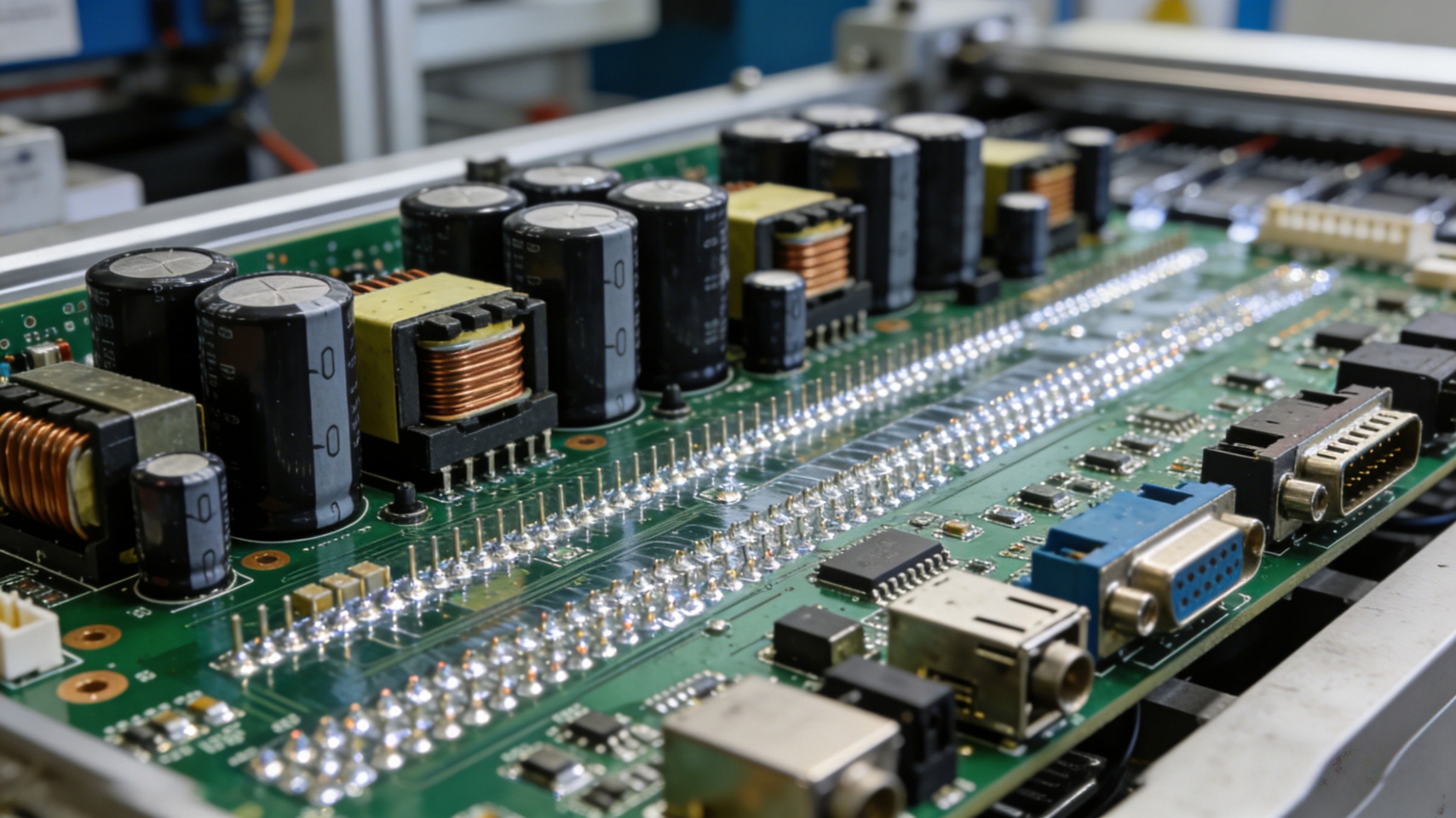
Through Hole PCB Assembly
Reliable Through-Hole (THT) PCB Assembly Services
Expert Mixed-Technology & THT Solutions Don't let legacy components slow down your production. Runhi Electronic seamlessly integrates Through-Hole Technology into modern manufacturing workflows. We tackle the challenges of Mixed Assembly—protecting your SMT parts while wave-soldering robust THT connectors and power relays. - Diverse Capabilities: From manual insertion of odd-form parts to automated wave soldering. - Post-Assembly Care: We offer Conformal Coating and Potting services to ruggedize your THT boards against moisture, vibration, and dust. - Testing: Full functional testing to guarantee connection stability before shipment.
While Surface Mount Technology (SMT) dominates miniaturization, Through-Hole Technology (THT) remains the gold standard for products requiring extreme mechanical strength and high power handling.
At Runhi Electronic, we excel in Mixed Technology Assembly (SMT + THT). We combine the precision of automated insertion machines with the flexibility of skilled manual assembly lines. Whether you need robust connectors for industrial controllers or heavy transformers for power supplies, our Dual-Wave Soldering and Selective Soldering processes ensure every joint provides a mechanical bond strong enough to withstand vibration, thermal stress, and high current.
Our THT Capabilities Include:
- Manual & Automated Insertion: Flexible lines for both prototypes and mass production.
- Wave Soldering: Lead-free / SnPb dual-wave soldering for consistent quality.
- Selective Soldering: For precise soldering near sensitive SMT components.
- Conformal Coating: Protecting your THT boards from moisture and dust in harsh environments.
Why THT is Still Critical?
Even in the age of SMT, Through-Hole technology is essential for specific applications where reliability is non-negotiable:
- 💪 Mechanical Strength: THT provides strong mechanical bonds for components that undergo physical stress, such as I/O connectors, switches, and heavy capacitors.
- ⚡ High Power Handling: THT components typically handle higher currents and voltages than SMDs, making them essential for Power Supplies (PSU), Inverters, and LED Drivers.
- 🛠️ Durability: THT offers superior resistance to environmental stress, vibration, and shock, making it the preferred choice for Automotive and Aerospace electronics.
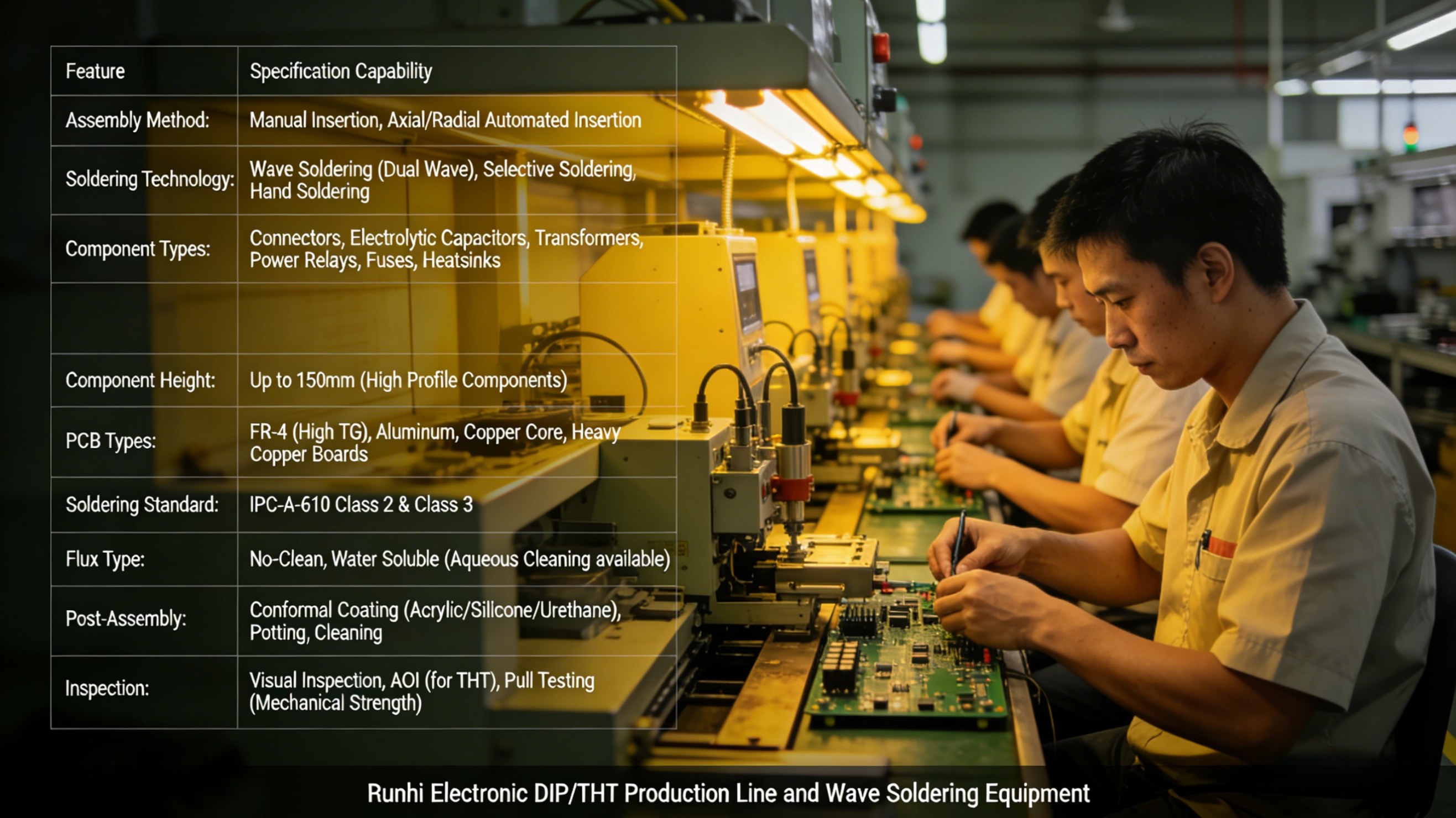
Technical Capabilities
Our facility is equipped to handle complex mixed-technology boards from simple consumer electronics to heavy-duty industrial units.
Feature | Specification Capability |
Assembly Method | Manual Insertion, Axial/Radial Automated Insertion |
Soldering Technology | Wave Soldering (Dual Wave), Selective Soldering, Hand Soldering |
Component Types | Connectors, Electrolytic Capacitors, Transformers, Power Relays, Fuses, Heatsinks |
Component Height | Up to 150mm (High Profile Components) |
PCB Types | FR-4 (High TG), Aluminum, Copper Core, Heavy Copper Boards |
Soldering Standard | IPC-A-610 Class 2 & Class 3 |
Flux Type | No-Clean, Water Soluble (Aqueous Cleaning available) |
Post-Assembly | Conformal Coating (Acrylic/Silicone/Urethane), Potting, Cleaning |
Inspection | Visual Inspection, AOI (for THT), Pull Testing (Mechanical Strength) |
THT Applications
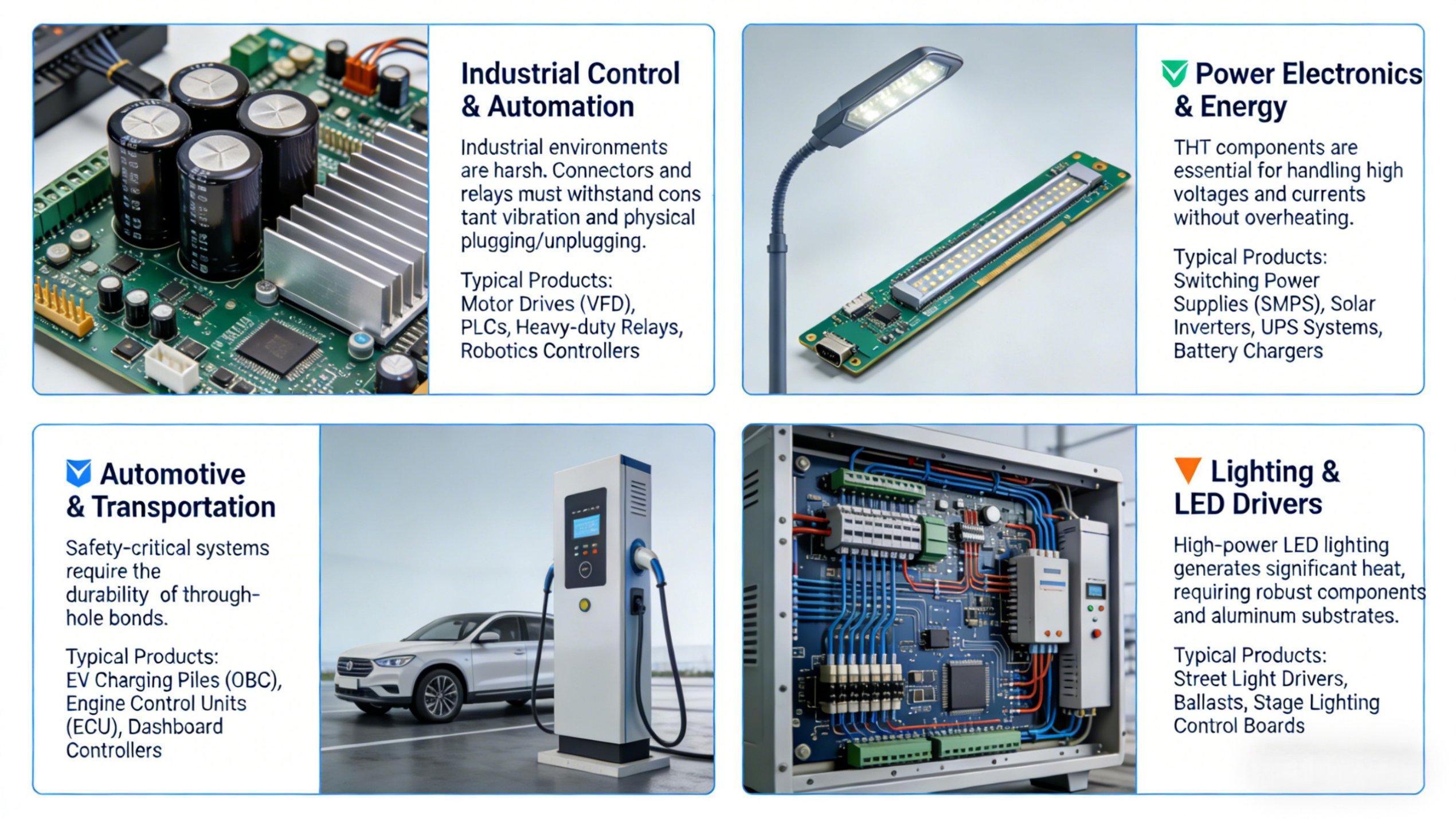
Runhi Electronic delivers THT solutions for industries where failure is not an option.
🏭 Industrial Control & Automation
Industrial environments are harsh. Connectors and relays must withstand constant vibration and physical plugging/unplugging.
- Typical Products: Motor Drives (VFD), PLCs, Heavy-duty Relays, Robotics Controllers.
- Runhi’s Role: Our wave soldering process ensures 100% hole penetration, preventing connector failure in the field.
⚡ Power Electronics & Energy
THT components are essential for handling high voltages and currents without overheating.
- Typical Products: Switching Power Supplies (SMPS), Solar Inverters, UPS Systems, Battery Chargers.
- Runhi’s Role: We ensure perfect solder fillets on heavy transformers and coils to manage thermal stress effectively.
🚗 Automotive & Transportation
Safety-critical systems require the durability of through-hole bonds.
- Typical Products: EV Charging Piles (OBC), Engine Control Units (ECU), Dashboard Controllers.
- Runhi’s Role: We adhere to strict quality standards, offering Conformal Coating to protect THT boards from moisture, dust, and chemical exposure.
💡 Lighting & LED Drivers
High-power LED lighting generates significant heat, requiring robust components and aluminum substrates.
- Typical Products: Street Light Drivers, Ballasts, Stage Lighting Control Boards.
- Runhi’s Role: We handle complex assembly involving large electrolytic capacitors and heat sinks required for thermal management.
Our Process & Quality Control
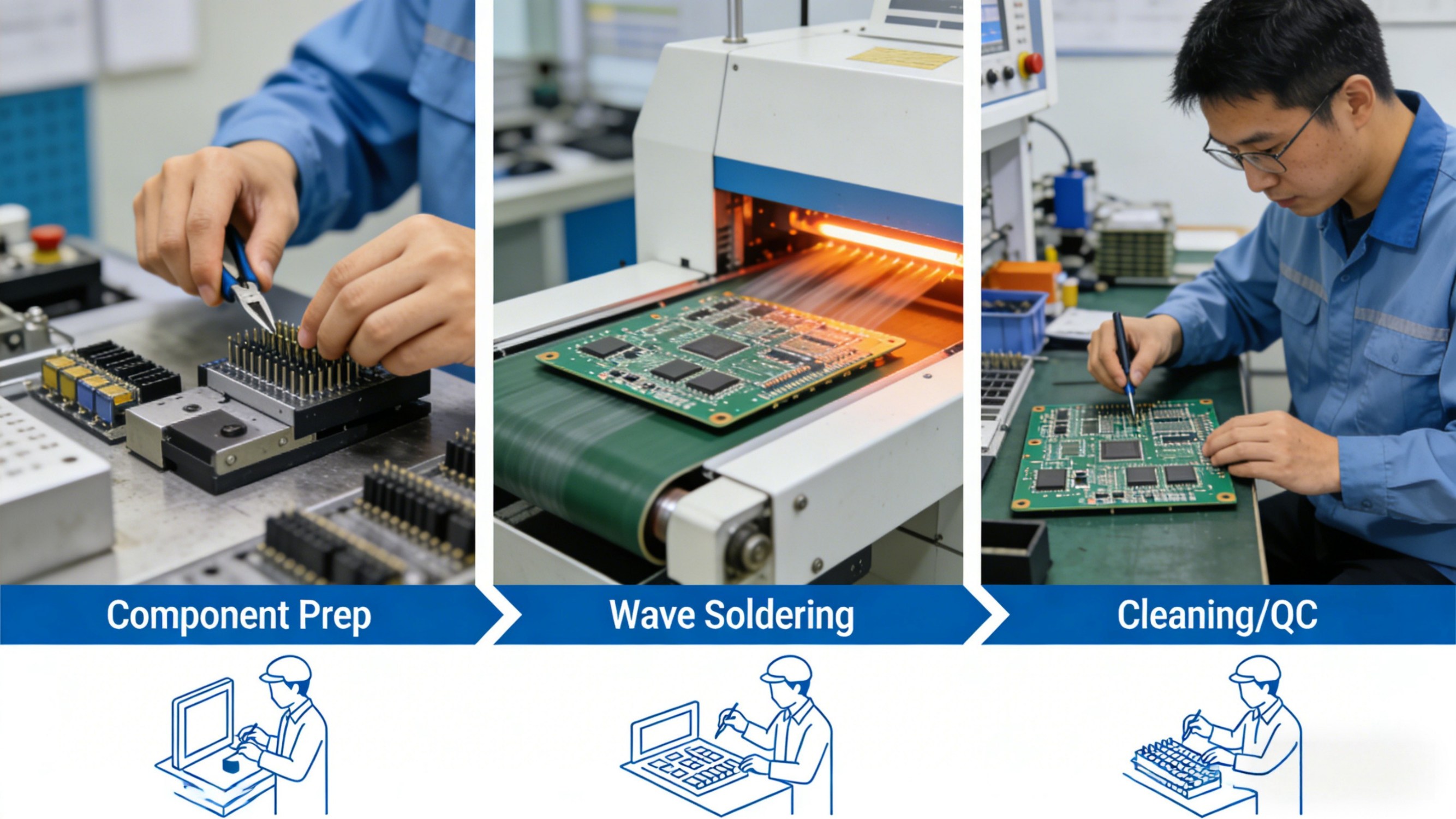
Through-hole assembly relies heavily on process discipline. Runhi implements a strict workflow to prevent common defects like "cold solder" or "insufficient wetting."
- Component Preparation: Precision lead forming and cutting to ensure components fit perfectly into the PCB holes.
- Fixture Design: We design and fabricate custom Wave Soldering Pallets in-house. These fixtures shield SMT components on the bottom side while exposing THT leads to the solder wave.
- Wave Soldering Profile: We strictly monitor the pre-heat temperature (80°C-130°C) and solder pot temperature (255°C-265°C) to ensure 100% barrel fill.
- Inspection & Cleaning: Every THT board undergoes visual inspection. For high-voltage boards, we perform ultrasonic cleaning to remove flux residues, ensuring electrical safety.
Why Choose Runhi for THT Assembly?
- 👨🔧 Skilled Workforce: Unlike SMT which is fully automated, THT requires skilled hands. Our operators have an average of 5+ years of experience in manual insertion and hand soldering, ensuring consistency even for complex builds.
- 🔄 Mixed Assembly Experts: Most boards today are SMT+THT. We optimize the workflow (Reflow first -> Wave second) to ensure no damage occurs to sensitive SMT parts during the THT process.
- 💰 Cost-Effective Tooling: We have an internal team to design wave soldering fixtures, reducing your NRE costs and speeding up production lead time.
Frequently Asked Questions (FAQs)
Process & Capabilities
Q: What is the difference between Wave Soldering and Selective Soldering?
A: Wave Soldering passes the entire board over a wave of molten solder, ideal for mass production. Selective Soldering uses a programmable mini-wave to solder specific points individually. We use Selective Soldering for boards densely populated with SMT parts on the bottom side to avoid thermal damage.
Q: Can you handle component lead forming?
A: Yes. We use automated forming machines to cut and bend component leads (axial/radial) to the exact pitch required by your PCB layout, ensuring a perfect fit and stress-free insertion.
Q: Do you support Lead-Free (RoHS) wave soldering?
A: Absolutely. We have dedicated Lead-Free (SAC305) wave soldering pots to comply with RoHS regulations. We also maintain separate Leaded (SnPb) pots for specialized military or medical applications exempt from RoHS.
Quality & Services
Q: How do you clean the boards after THT assembly?
A: Flux residue can cause corrosion. We utilize Ultrasonic Cleaning and Aqueous Wash Systems to remove flux residues (especially for water-soluble flux), ensuring the board meets IPC cleanliness standards.
Q: Can you install heat sinks and mechanical hardware?
A: Yes. THT assembly often involves mechanical work. Our team is experienced in applying Thermal Grease, screwing on Heat Sinks, and installing brackets, spacers, or shielding cans during the assembly process.
Q: My board has SMT on both sides and THT. How do you assemble it?
A: This is a "Mixed Technology" board. Our workflow is:
- SMT Assembly (Top Side) -> Reflow.
- SMT Assembly (Bottom Side) -> Reflow (using red glue if needed).
- THT Assembly -> We design a custom Wave Solder Pallet (fixture) to cover and protect the bottom SMT parts, exposing only the THT leads to the wave solder.